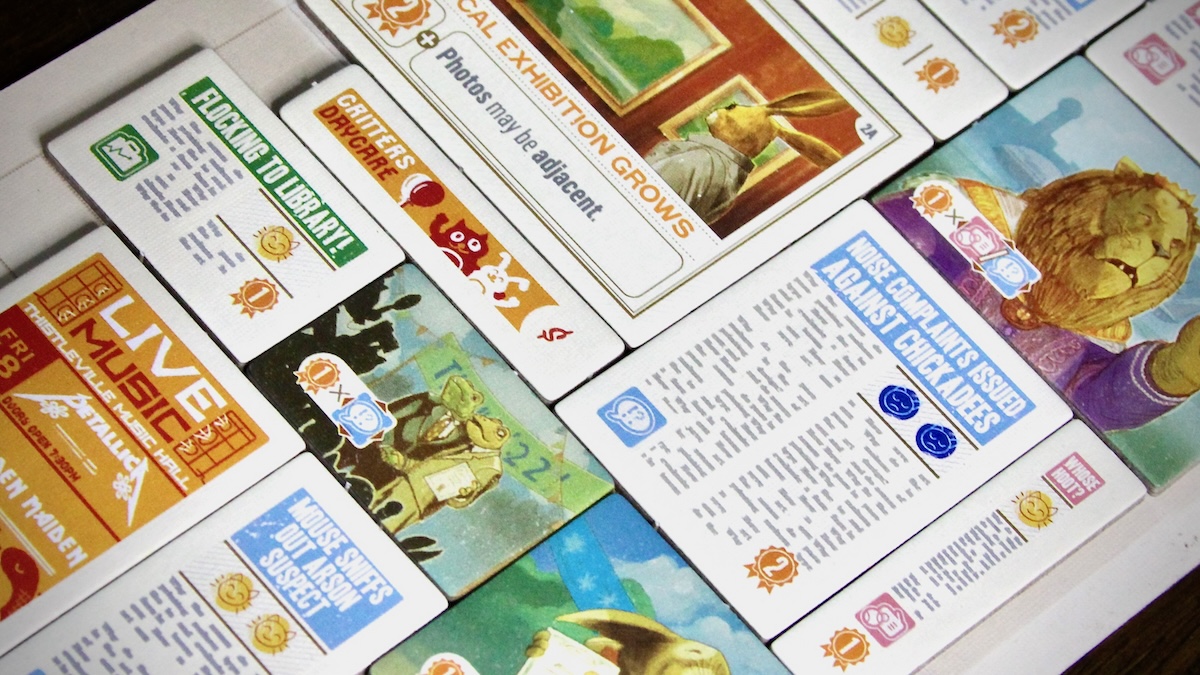

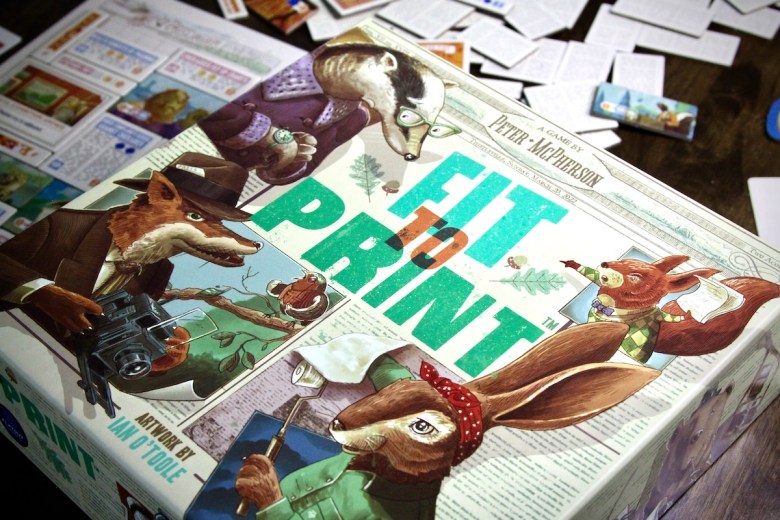
Thistleville is a bustling town of anthropomorphic woodland creatures, activity, and news outfits. As the editor of one of the local newspapers, it’s your job to tell the stories of life in this busy place. Do you have what it takes to be the most newsworthy editor in Thistleville?
Rush to fill your desk with newspaper tiles, then arrange them to create a proper balance of photos, articles, ads, and more. To score well it is crucial to balance the mood of your paper with a mixture of positive and negative stories, to fill your page with content, and meet various placement requirements. This simultaneous-action game has no turns – players complete both round phases at their own pace. But just like a real-life newspaper, there are deadlines. A timer adds a real-time element to turn up the pressure!
Game at a Glance
- Alderac Entertainment Group, Flatout Games
- 15-30 mins
- 1-6 players
- Ages 10+
- A review copy of this game was provided by the publisher; however, my opinions are my own
Skip to Review; Skip to Final Thoughts
Overview
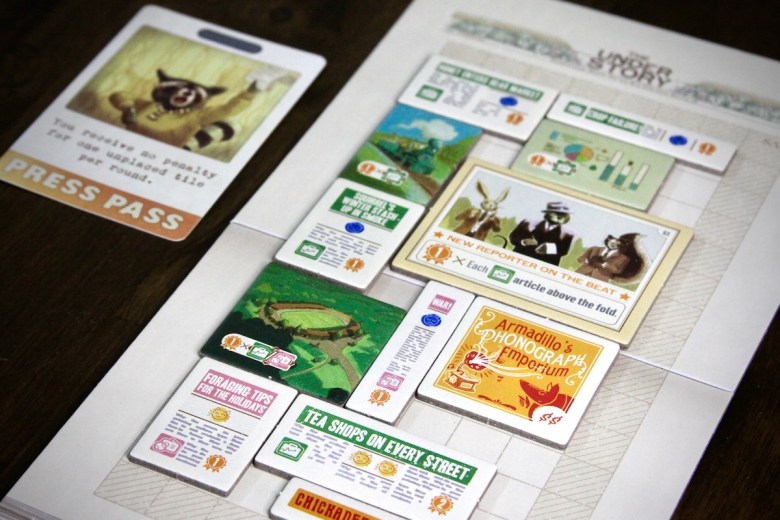
In this competitive tile placement game, up to six players are given a newspaper player board, a starting centerpiece tile, a 3D desk, and a character card that doubles as a player aid. All 120 newspaper tiles are scattered face-down in the center of the table within reach of all players.
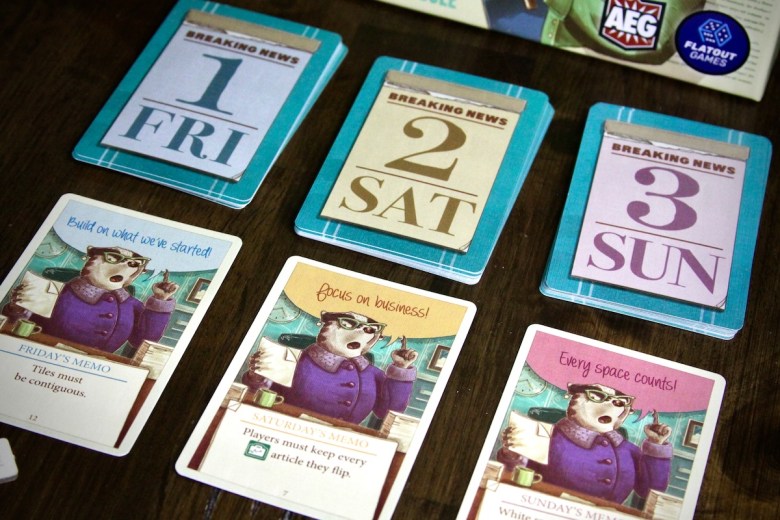
The game is structured into three rounds, represented by days. Players will spend these rounds creating a Friday, Saturday, and Sunday edition of their papers. Each round consists of two phases: reporting and layout. During reporting players pick tiles with one hand, determining whether to keep them before choosing another. Kept tiles are placed on the 3D desk for use in the layout phase while the unwanted ones are returned to the pile, faceup, for other players to consider. When players feel they have the right amount of tiles to fill their newspaper, they move onto the layout phase where they arrange what they have onto their newspaper board, following placement rules and trying to score points. The phases are timed, and players may decide to skip to layout whenever they choose; however, they may not revisit the reporting phase after the tile arrangement begins.
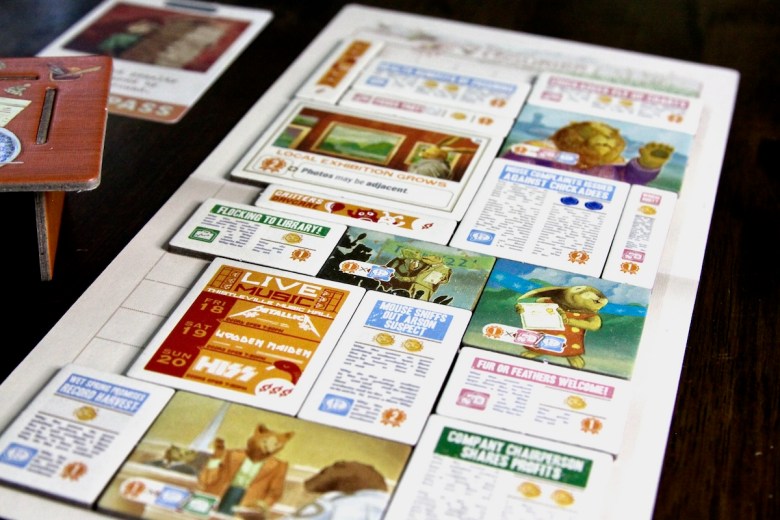
For a tile to score it needs to follow certain placement rules. Tiles of the same category must not touch each other. For example, photos should not be adjacent to other photos orthogonally, etc. In the advanced version additional restrictions or abilities to bend these rules might come into play.
After the timer ends, players assess their score based on several parameters and move to the next round. After the Sunday edition is scored, the points are tallied and the player with the highest score wins.
Review
Fit to Print tossed that idea of a slow-paced tile placement game on its head by infusing it with the frantic energy that comes with real-time games. The puzzle stems from the tile categories, placement restrictions, and penalties. There is much to consider each round, but limited time for point maximization.
The puzzle requires players to fill out the newspaper board while following placement restrictions and maximizing scoring parameters. The right balance and placement of articles and photos are crucial. Both fall into color-coded categories and have associated moods – good news, or bad news. Articles have base point values and placing them next to a matching photo allows that photo to score. The more orthogonal matches a photo has, the better it will score. Advertisements aren’t worth points, but they pay the bills. As tempting as it might be to forgo adding them to your paper, the player with the least amount of ad revenue at the end will go out of business and lose the game. It may sound harsh but I feel works well in the game.
There are penalties to consider as well. Leaving large white spaces on your board can cost you, and having unplaced tiles is also problematic. Estimating the amount of tiles needed, not too many, not too few, is important to have the “Goldilocks” amount of tiles to work with. Balancing the mood of your paper is important, too. A paper too heavy on doom and gloom or saccharine puff pieces will lose points.
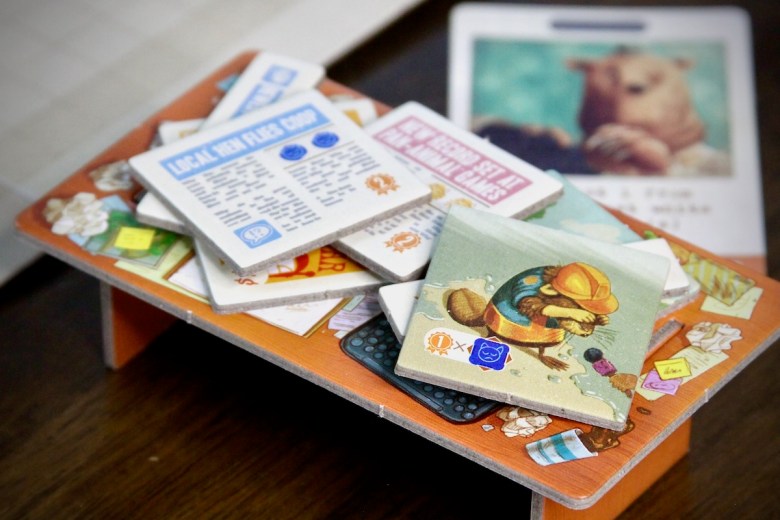
The puzzle is interesting but not groundbreaking when compared to similar tile placement games available today. What sets this one apart from the others is the real-time element. Each round is completed while a timer ticks away forcing players to scramble while choosing and placing their newspaper tiles. During the reporting phase, tiles are haphazardly stacked on the 3D desks, making it difficult to visually assess if you have enough tiles to fill out your article or the right balance of tile categories for a decent score. And trying to follow every placement rule perfectly while the clock is ticking down is extremely tough. You have to be comfortable with imperfection and chaos because you will not have a chance to consider the ideal placement of each tile during the frantic rush to get something, anything, into that newspaper. There are also incentives to play quickly as the best centerpieces for the next round will go to the person who finished first. The tension is palpable!
Experience will likely give players an edge over those who haven’t played Fit to Print before. They will have an easier time guestimating how many tiles to take for each phase and will be less likely to forget placement restrictions. It is possible to use basic math skills to determine the approximate number of tiles needed, but this is muddied by the fact that the tiles come in a variety of sizes, orientations, and rectangle shapes. Combine that with the need to balance several elements and follow restriction rules and it becomes less of a math puzzle than a “grab some and pray for the best” situation, especially for new players.
This is an incredibly customizable game. The rules suggest three different round times depending on how relaxed or frantic you prefer your game to be. Five minutes is considered the relaxed time, but players are encouraged to increase the time to whatever makes the group comfortable. Additionally, there are optional modules that add restrictions and/or add bonuses and rule-breaking abilities. These are great for upping the game’s difficulty and replayability. Finally, there are two official variants (not including the solo mode): Family Mode which strips the game down to a more basic form suitable for younger players, and Turn-based Mode which eliminates the real-time aspect in favor of an ordered draft. The built-in flexibility with the rules ensures that just about any audience can successfully play Fit to Print.
Final Thoughts
I appreciate how the theme and mechanics tie in together. The rush to meet deadlines and the balancing of moods, articles, photos, and ads all work perfectly with the theme of periodical publication. I found the art style and animal puns on the tiles charming and the symbols easy to understand.
As far as the tile placement puzzle is concerned, there is a balancing act that shines for me. I often felt I was on a tightrope trying to strike an equilibrium between positive and negative stories while at the same time choosing the right size and orientation of tiles to fill my play area. Additionally, there’s a balance in ad space – place too many ads and you lose out on space for scoreable tiles, but losing the advertising race to the competition means losing the game. It’s a tricky conundrum that I found enjoyable.
I found the tile laying element interesting on its own, but not superior to similar games from this publisher such as Cascadia and Calico. The pressure from the timer is what makes the tile placement puzzle shine and I would not play Fit to Print without it. But that stress will not appeal to all gamers – I found out the hard way when introducing this to my children.
The puzzle of choosing complimentary tiles, approximating how many you’ll need to fill the space, balancing all the elements, and placing them in a way that will score well is a lot to manage. Add the extra pressure that comes with the timer and you have a mix that can be chaotic fun, or a deal-breaker – depending on the audience. If you enjoy games like Galaxy Trucker, this could be a solid choice for game night. But if real-time games make you stressed and shut down, there are plenty of fantastic tile placement games without the timed element built in that I would pick up first, despite the game offering a turn-based mode.
 Tabletop Mom
This game sounded interesting but the real-time element kind of scares me. Probably why I won’t end up playing it. But great review!
LikeLike
Thank you. Yes the real time seems to be a bit on the stressful side for those of us who struggle with those games. I am more of a methodical player so I was definitely out of my comfort zone!
LikeLiked by 1 person
I have never played a game like this. I do like to try all types of games though. I am pretty methodical in my game style so I wonder how that would translate.
LikeLike