
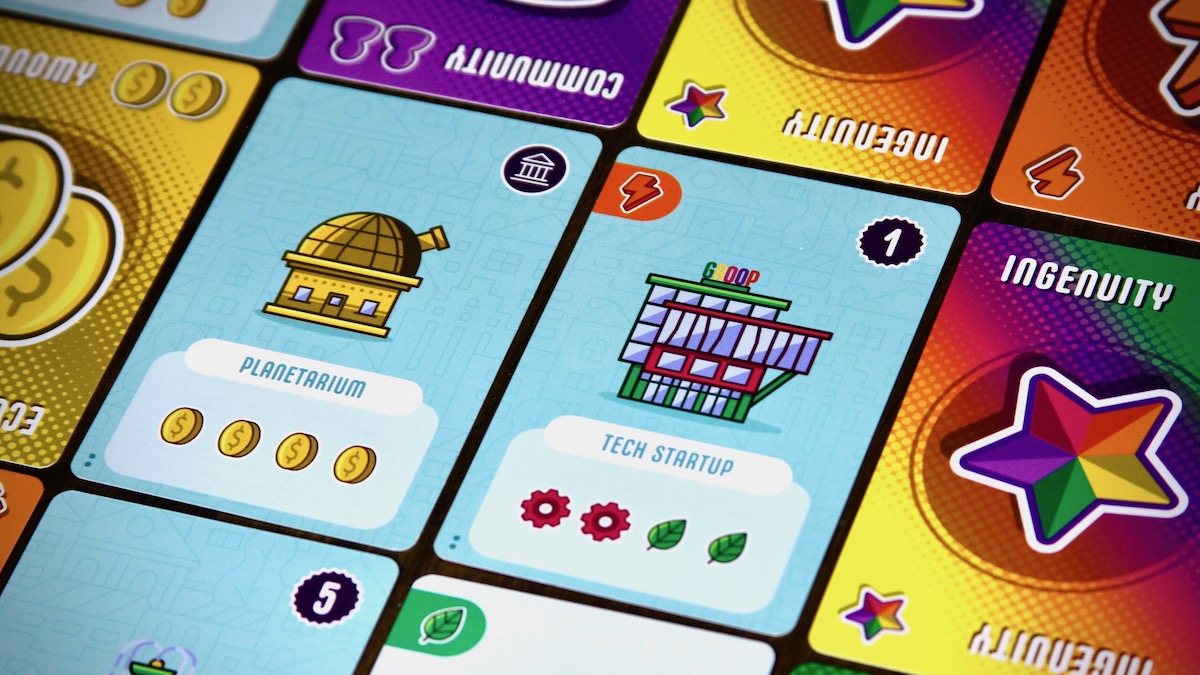

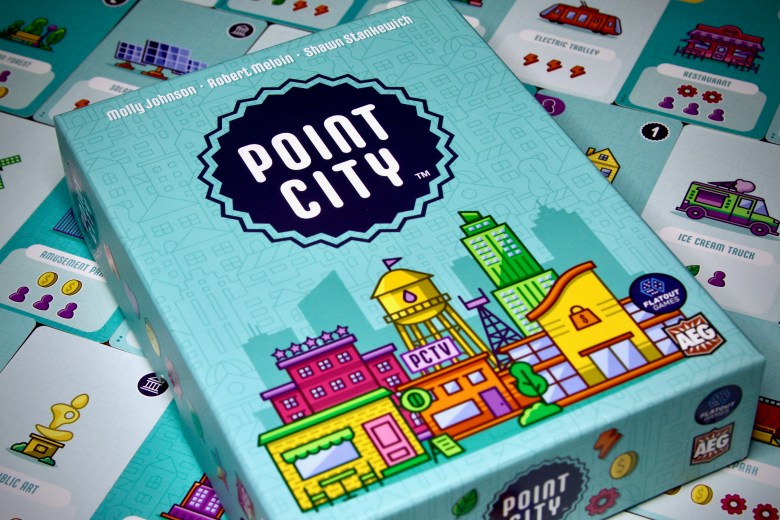
Since 2019 the tabletop gaming world has been getting their greens by drafting veggie cards into Point Salads. I would say we were long overdue for the next course. But rather than getting Point Soup or Point Dessert the team at Flatout Games has come from an entirely different angle with Point City!
Despite the new thematic direction, this follow-up does have quite a few things in common with its predecessor, such as mechanics (open drafting and set collection), graphic design, and double-sided cards. But a few minor differences lead to some pretty major changes in how the game is played – most notably the addition of resources.
In my Final Thoughts, I’ll make a quick compare/contrast of the two games for those interested in my opinions on how they stack up against each other. But first, let’s examine Point City on its own merits.
Game at a Glance
- Flatout Games, Alderac Entertainmentent Group
- Players: 1-4
- Time: 15-30
- Age: 10+
- A review copy of this game was provided by the publisher; however, my opinions are my own
Skip to Review; Skip to Final Thoughts
Overview
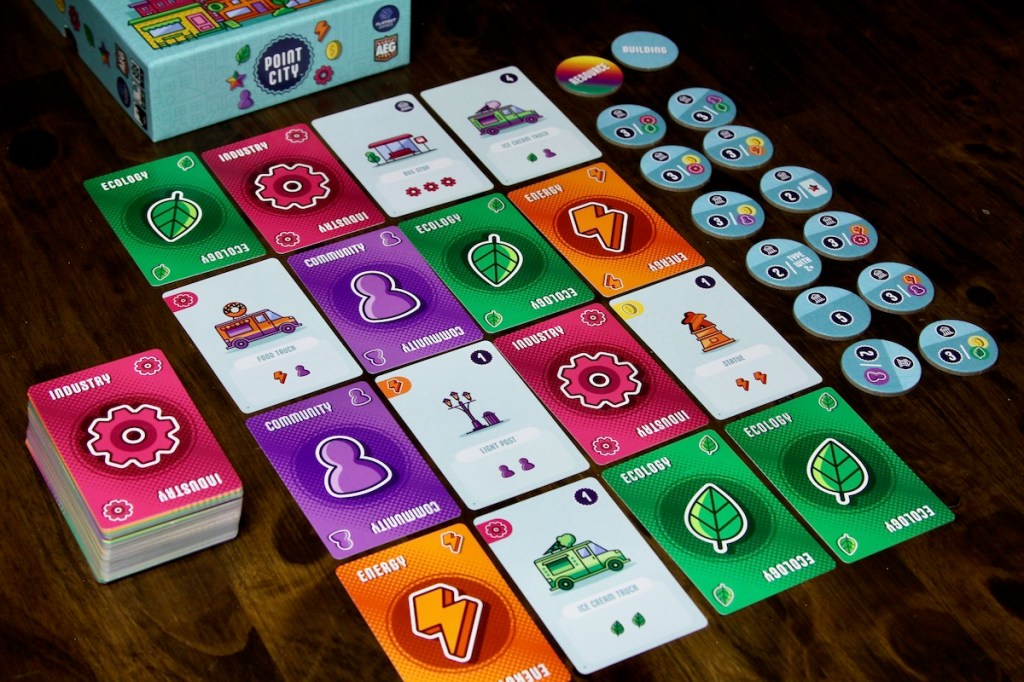
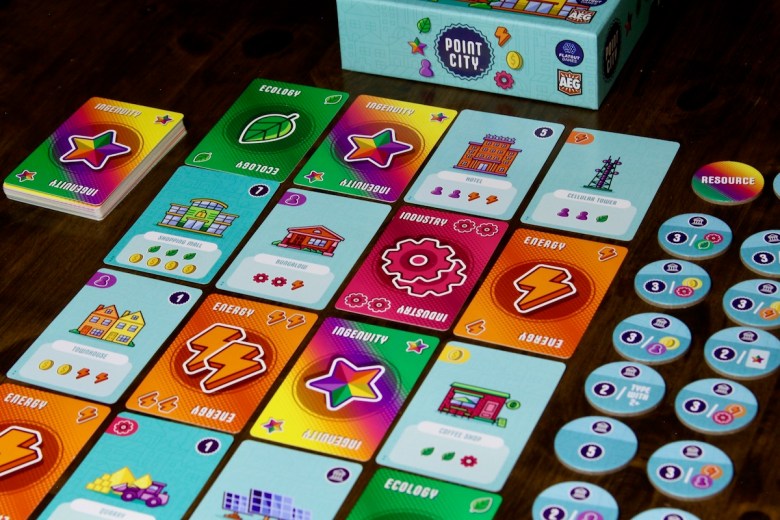
Point City is a relatively quick game where everyone competes to build the best, most point-getting city. This is achieved by drafting cards from a 4×4 grid. Each turn select two orthogonally-adjacent cards from this grid and add them to your city. Alternatively, you may take the top two cards from the draw pile.
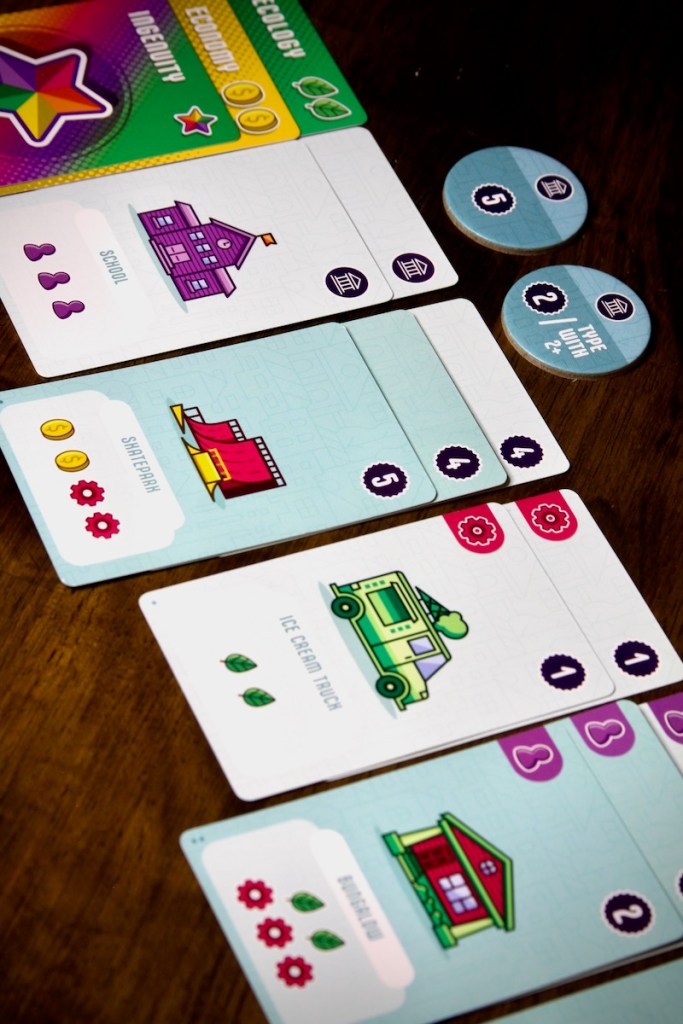
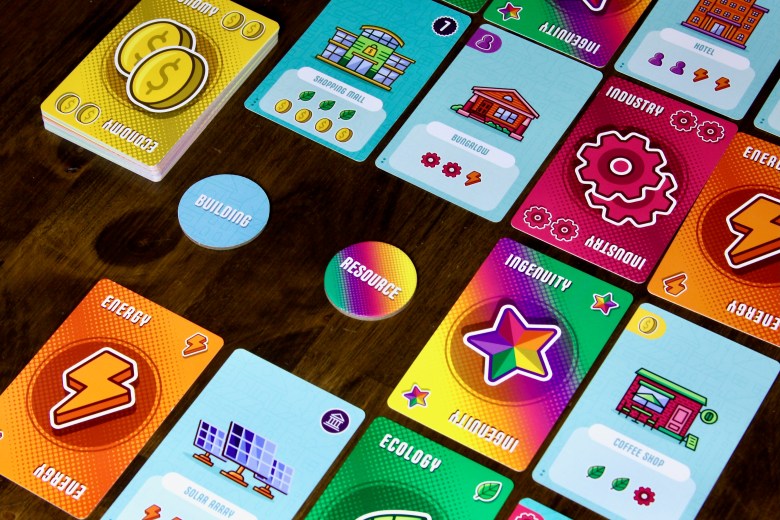
Each of the 150 cards included in the game is double-sided with a Resource side and a Building side. City development isn’t cheap, and building structures takes resources. Fortunately, building up your city makes it more productive and many buildings give back in the form of permanent resources. Buildings may also grant points or the ability to choose a Civic Token, which grants conditional victory points. Resource cards are free to draft from both the market and the top of the deck, but Building Cards cannot be drafted unless they can be paid for – either by discarding Resource Cards, using permanent resources (provided by previously constructed Building Cards), or a combination of the two.
After cards are drafted from the market grid, they must be replaced in a particular order and oriented on the opposite side of the card it is replacing. For example, two drafted resources will be replaced in the market with two buildings.
Play continues until the draw pile has emptied – each player getting exactly 17 turns. Points are scored based on constructed buildings and Civic Token bonuses.

Review
Gameplay
Point City is a highly tactical game, but there is plenty of room for strategy. The Civic Tokens allow players to hone in on which building types they might want to focus on, especially if they can collect one or two tokens early in the game that complement each other. The Civic Buildings tend to be costly, but they can provide the players with a strategic focus that just might pay off in the end. Some players might choose to concentrate on not focusing – by that I mean by opportunistically taking the highest-point-building Cards whenever possible and worrying less about the Civic Token bonuses. I have seen both strategies win.
This is a quick engine builder – rather than spending a lot of time tinkering with and perfecting your engine, you will be best served by trying to concentrate on a few strategic pathways early on, cobble something together quickly, and hope it works out before your 17 turns are up. There is some randomness in how the cards arrive in the market, which can make achieving any goals you set early difficult so flexibility and tactical play is still important. There is some randomness and luck built into the game. but anecdotally I will say that having skill is crucial. My husband is adept at engine builders and his nearly unblemished winning record in Point City reflects this.
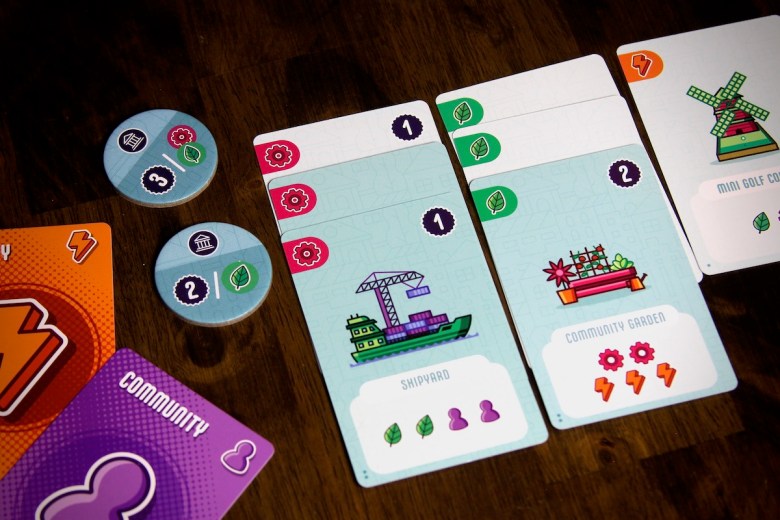
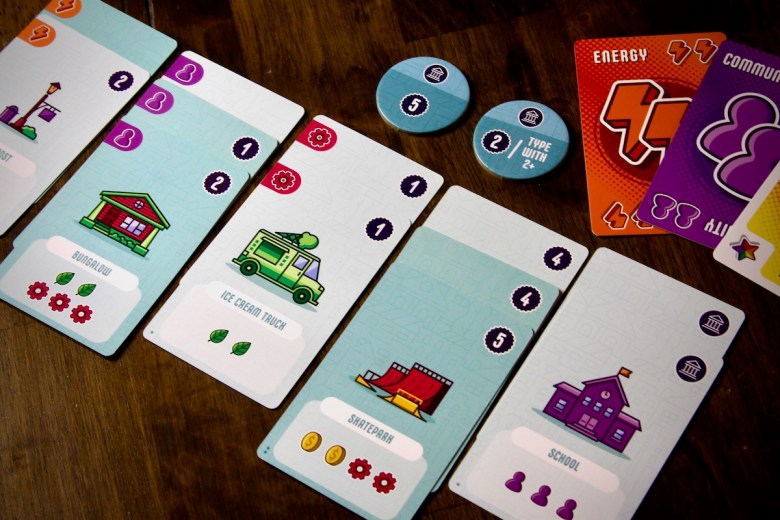
The adjacency drafting restriction is simple enough, but it adds a crucial layer of challenge to the puzzle. It’s nice when the resource you need is nestled up next to the building you want, but the market shifts quickly, and sometimes the adjacency rule makes the draft tough. More than once I have stared longingly at a building I desperately needed but couldn’t access due to it being encased by buildings couldn’t afford or didn’t want to draft. It’s possible to save up resources to bust an imprisoned building loose, or hope another player releases it. This drafting constraint keeps players from being able to meet all their needs too easily and I think is necessary to keep Point City interesting.
Remembering where your drafted cards came from might be the most difficult part of the game. Of course, you could use the included reminder tokens, but I have just as much luck remembering to use them as I do remembering the orientation of the cards I just grabbed because I’m eager to take my turn. The system is a bit clunky and takes some getting used to but we have gotten better at it with repeated plays.
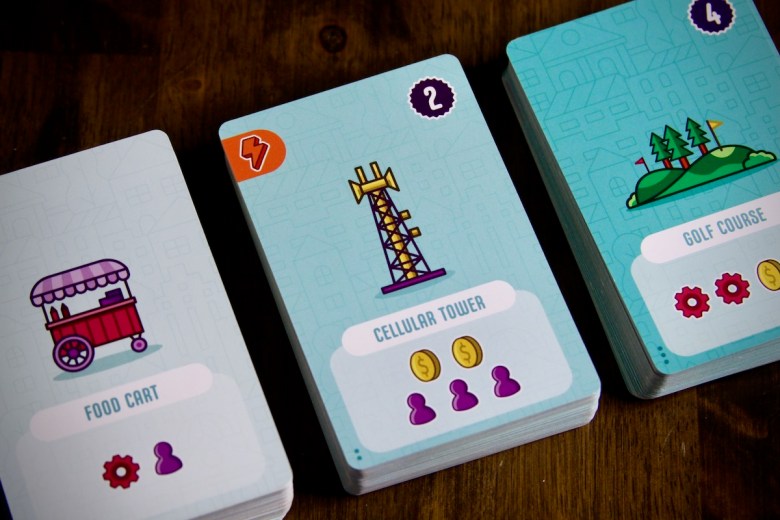
The deck is divided into three tiers of cards, and during setup, each tier is stacked in a way that the game has an arc. It starts slowly with single-resource cards and low-powered, yet inexpensive buildings. By the time the players are drawing into Tier 3 cards the building costs are much more expensive, but at the same time, there is a higher frequency of double-resource cards and by then the players’ cities (hopefully) should be able to offset some of the rising costs. This tiered deck allows players to grow their cities at a similar pace to the game arc. Even with an efficient resource engine, many buildings will still be out of reach without the help of expendable resources, so there is still a challenge to overcome at every level. And there’s a bit of excitement each time a new tier of cards emerges from the deck. This deck-stacking works extremely well in the game.
Speaking of the deck, any slight handling of it often leaves the second card in the stack slightly visible even though it is supposed to remain unknown. A neutral border on the resource side might have alleviated that issue. This is a minor annoyance but not incredibly consequential for a game of this short length.
Weight
Point City is a lightweight game and works well as an entry-level engine builder or quick filler for more experienced gamers looking for something snappy. The rulebook is clear, concise, and gets right down to business. We were able to learn the game and have it up and running within minutes. Setup is fast – crucial for a game of this weight. It takes a bit of shuffling and deck manipulation to get the deck set up correctly, but overall it’s a snap with the reference sheet that is laid out on the back of the rulebook.
Replayability
There are 22 Civic Tokens in the box and every game a random sample will be taken and used as the scoring bonuses. Additionally, with the cards being double-sided it’s difficult to know which buildings will be seen from game to game. There are enough subtle differences in each session to keep it feeling fresh, but not enough to make it feel unfamiliar and unwelcoming to less experienced gamers. I would have liked to see more interesting Civic Tokens, and/or have more variety to choose from, but what is provided is adequate.
After my first game of Point City, my husband and I were ready to play it again immediately. This one is easy to play back-to-back, and after having had it for some time I am still finding myself willing to play it, several times in a row if others are willing or able. I am having fun exploring different balances in how to build my engine – sometimes my plans work out, other times they don’t. And because I’m still having fun, I am finding the replayability is pretty high.
Theme / Aesthetics
The theme works well with the mechanics. It makes sense that buildings cost resources, and by increasing the attractions and utilities of your city, they would in turn create permanent benefits for the entire city. There is an attempt to match the resource type to the buildings based on what they might cost in resources and what their output would be, too, but it’s not incredibly deep and worth over-thinking.
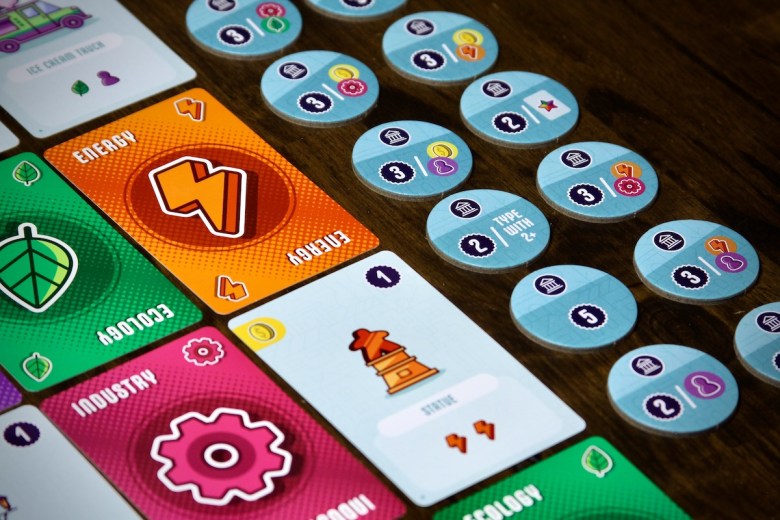
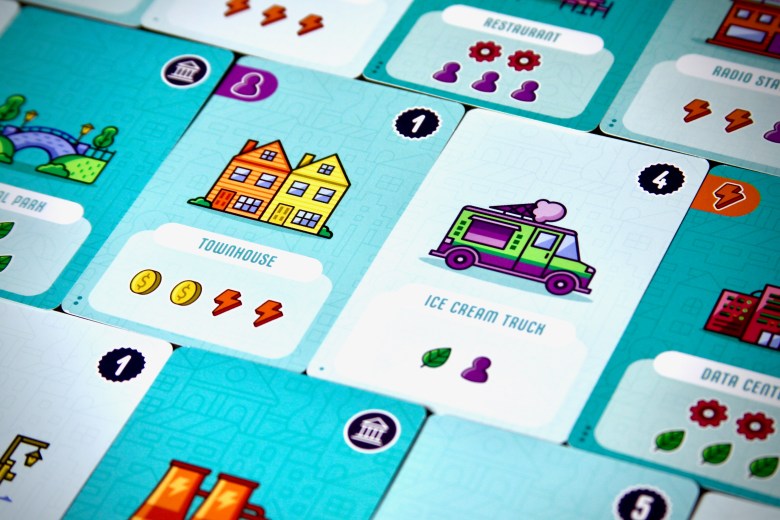
The color of the buildings matches the resource cost which is such a clever touch. I didn’t notice this until my son pointed it out, but now I see it every time I play and I love that added detail. On the topic of graphic design, the aesthetics are sleek and stylized and each building has unique art which is a nice touch (and a visual upgrade from its leafy predecessor). The game looks cohesive and representative of the Point brand and the symbology is easy to see and understand – I think everything is pretty excellent on this front.
The component quality is fine. The cards are thin but get the job done. The box insert holds the unsleeved cards and tokens and again, I don’t have any meaningful complaints here. If you are the card-sleeving type, you will likely need to toss the insert.
Interaction / Fun
Point City has some light interaction thanks to the shared market drafting. It’s not too difficult to pay attention to what opponents are working towards by taking note of the Civic Tokens and buildings they are collecting, and anticipating which have the potential to cause serious gains in points. A bit of blocking may happen from time to time, but the game hasn’t felt incredibly nasty or cutthroat to me so far. Losing out on a wanted building or token might have a slight sting, but it doesn’t feel devastating.
Point City is fast-paced, with light interaction and simple mechanics, and it allows players to get an engine-building experience in around half an hour. These types of games tend to have strong appeal, and this is no exception.
Final Thoughts
As the sequel to Point Salad, this game is inevitably going to draw comparisons. They both utilize open drafting and set collection mechanics and showcase double-sided cards. But the card functionality is different, with Point City’s cards moonlighting as resources instead of scoring conditions. The inclusion of resource management in Point City adds a level of depth that Point Salad can’t match. In addition, the adjacency restrictions placed on the market draft add unexpected challenges, and the tiered cards offer a satisfying arc to the game.
Point City is still a lightweight game but is a level-up from Point Salad in terms of weight and decision space. But Point Salad has an elegance that its sequel fails to match, and that is demonstrated when it is time to refill the market cards. This step feels clunky, even when the reminder tokens are in use.
This game scratches a strategic itch that Point Salad cannot touch, and if I had to choose between the two for my enjoyment, Point City would win every time. But that is not to say it is a replacement. If I were teaching a group of very green gamers or my youngest kid, I would go for greens, because in terms of simplicity and elegance, Point Salad is the winner, hands-down.
The balance of short game length, strategic “crunch” and light interaction hit a sweet spot that makes this a welcome addition to my pile of “weeknight games.” We play it often, usually a few games back-to-back, and I still feel accomplished when I can get something going with my little city engine. Finding a suitable balance between resource and point generation is a puzzle I enjoy exploring, and being able to do that in 30 or so minutes (sometimes faster) is a rarity. I enjoy deciding whether to chase Civic Buildings and Resource Buildings or play as an opportunistic point-building snatcher. And if my plans go awry, I can shuffle the decks and try again – there’s usually time to squeeze in another round!
If you’re a fan of small engine builders and looking for a great weeknight game, family game, or filler with a little extra “bite” than Point Salad has to offer, Point City is certainly worth a look.
 Tabletop Mom
I’ve been wanting to try this one at some point. It looks really great!
LikeLike