
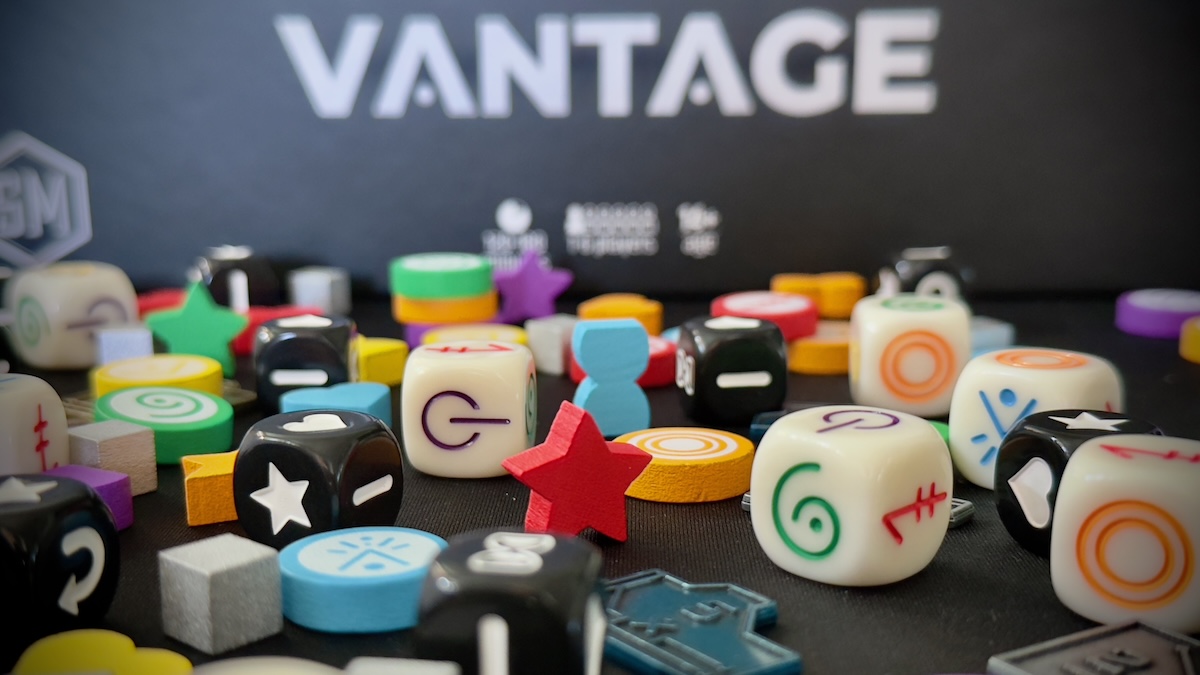

Premise: You and up to five crewmates are ejected from a malfunctioning spaceship and crash-land on an uncharted planet. Each player is scattered to a completely different area with no reliable way to meet up. You can communicate with your crew, but you can’t see their locations – only hear their descriptions. Armed with only your character card, a few skills, and a mission, you must explore the planet, interact with locals, gather resources, and fulfill your destiny.
I enjoy open-world video games, but the attempts to emulate these experiences on the tabletop have fallen a bit flat for me in the past. It was hard to ignore the buzz Vantage had been getting, so we decided to purchase this mysterious game and see if this was the one to change my mind.
I only have three plays under my belt so far, and it’s clear to me that writing a comprehensive review of this title will be challenging. Nevertheless, I typed up my experiences and thoughts and maybe they will give you some inkling as to whether this game is a good fit for you.
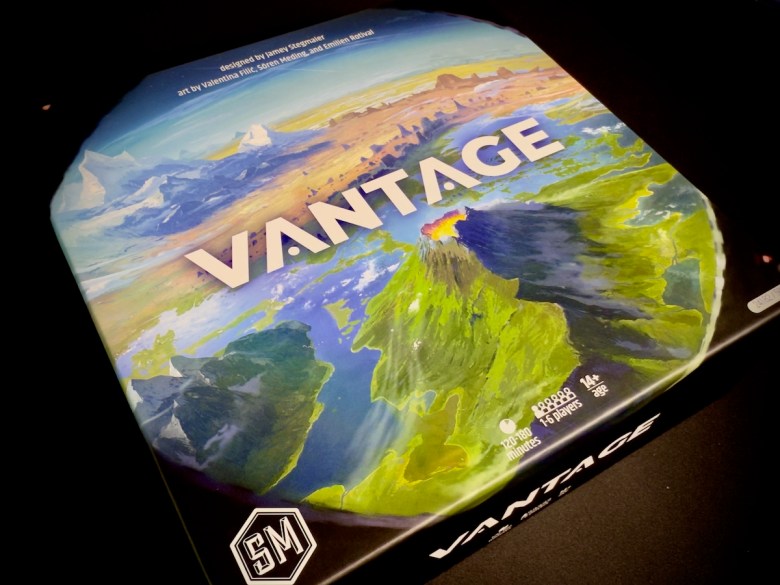
Game at a Glance
- Stonemaier Games
- 1-6 players
- 120-180 mins
- Ages 14+
Gameplay Snapshot:
- Each game is a self-contained story (not a campaign).
- Every playthrough offers different starting points and wildly varied experiences.
- Heavy emphasis on discovery, exploration, and narrative choices.
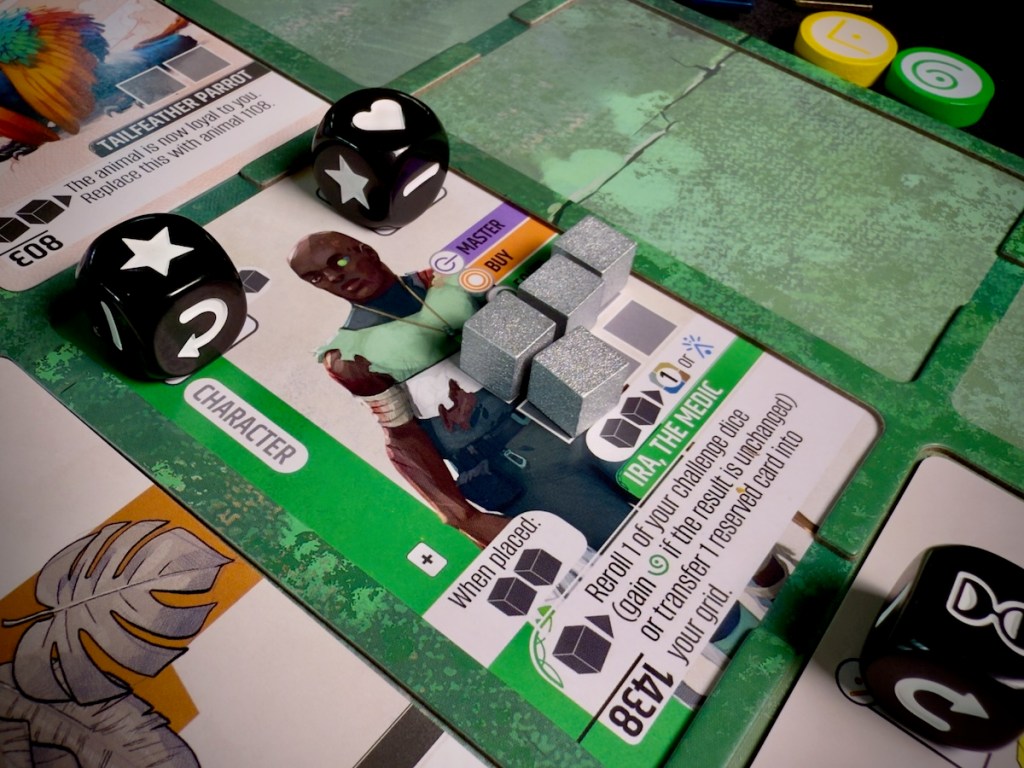
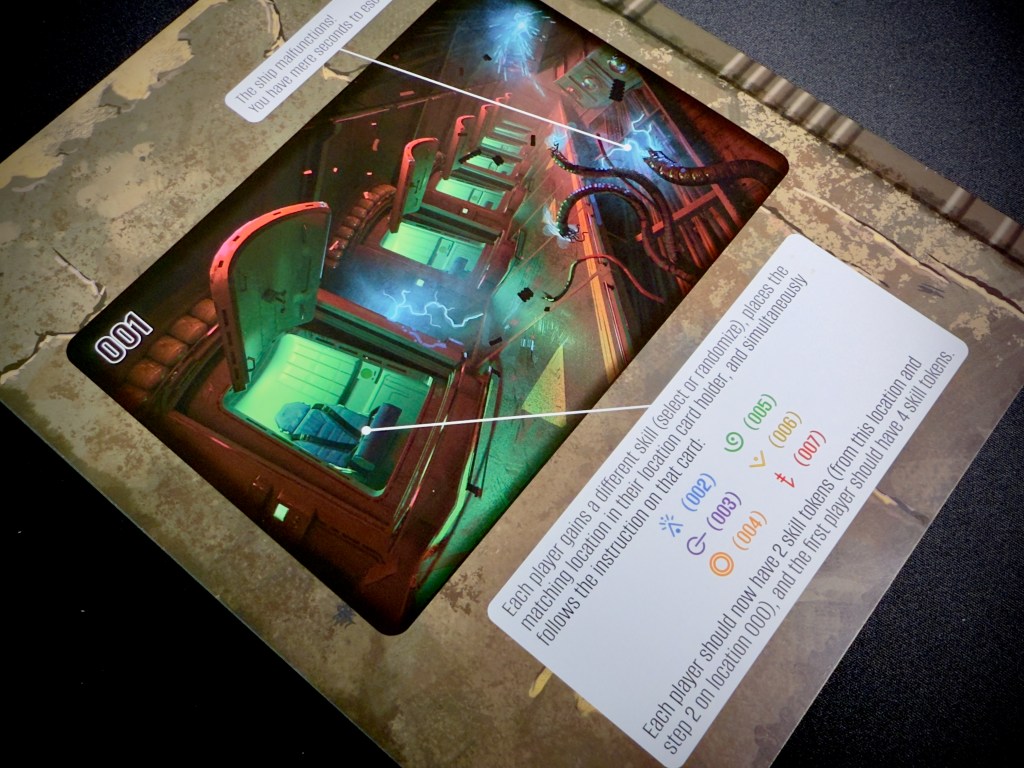
Each turn, players choose an action based on their location card (and sometimes from other cards collected during gameplay). Generally, there are up to six actions to choose from, based on different skills in the game. For example, if you’re on a shoreline with a tower and sentient creatures, you might have the option to scale the tower, examine the creatures, initiate a duel, etc. There’s always the option to completely exit the scene in one of four cardinal directions, opening up an entirely new location card.
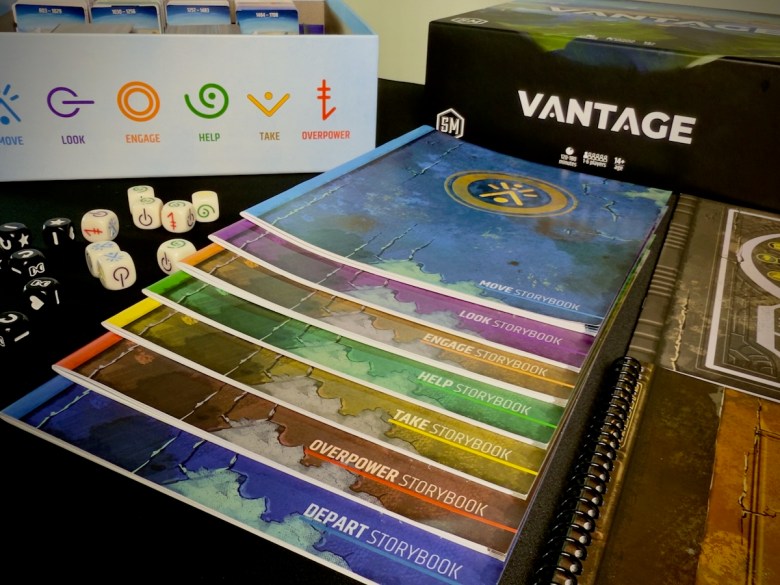
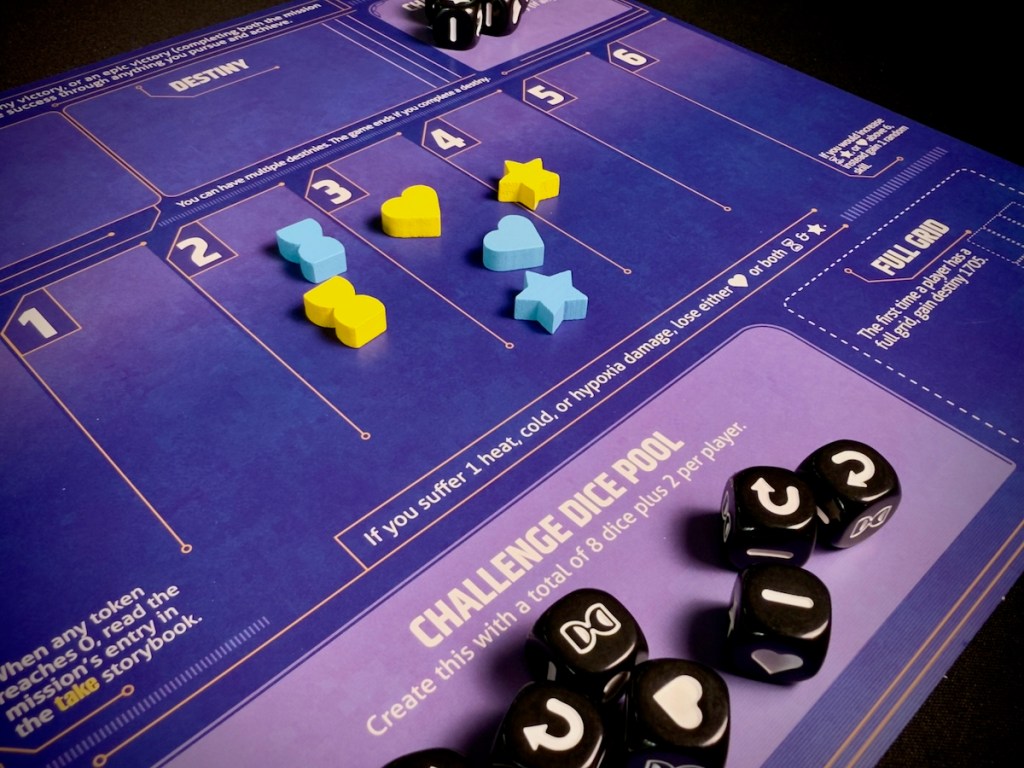
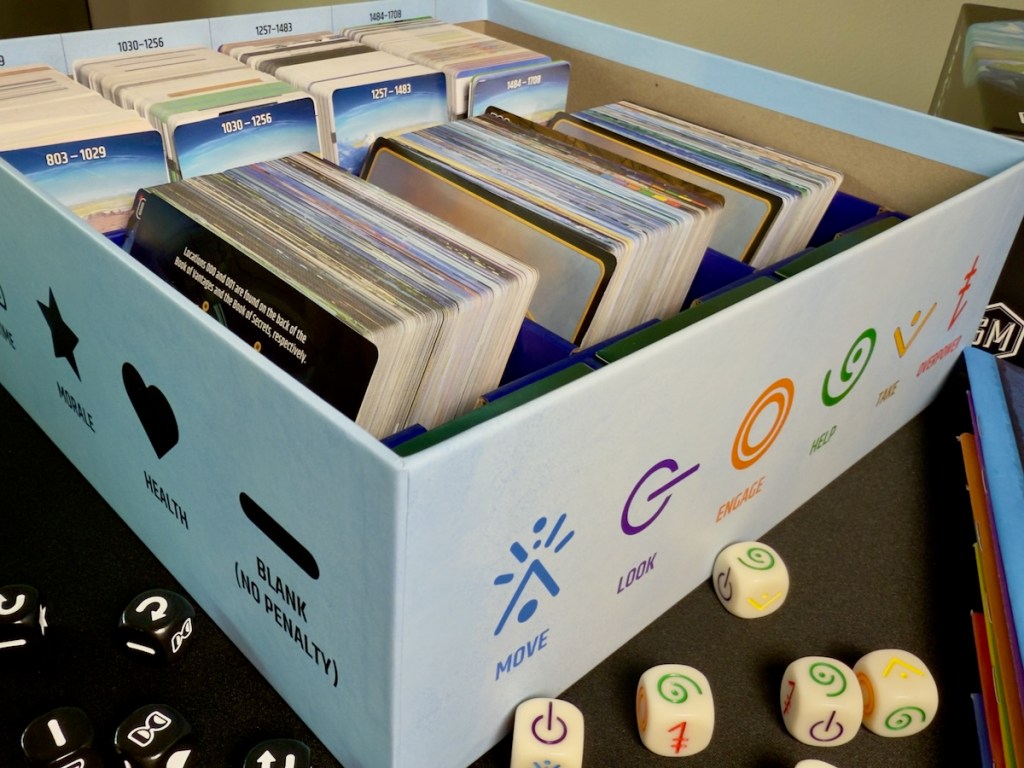
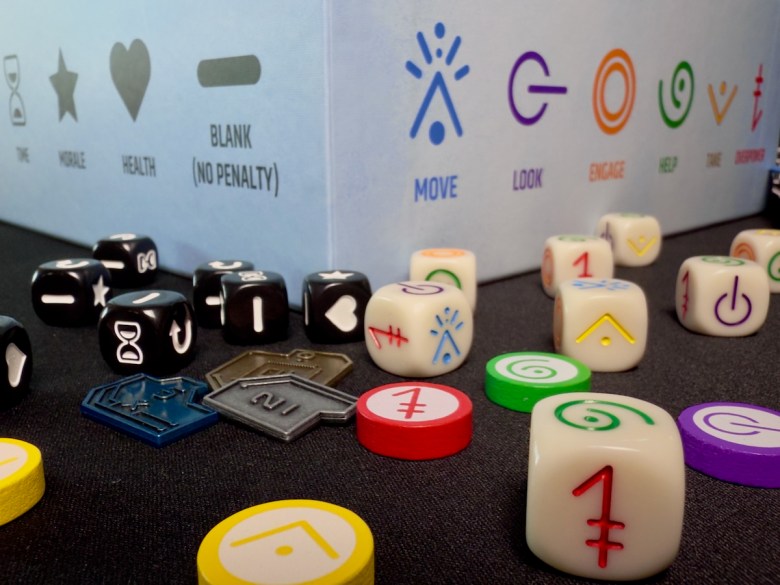
Each action will be related to one of six skills, each having a storybook with an entry for that action. Once the action is chosen, a skill check is presented, and a certain number of challenge dice must be rolled. Dice mitigation options are available either through spending acquired skill tokens or using open dice spots on cards. Dice rolls that cannot be mitigated will cause players to lose time, health, and/or morale. No matter how the skill check plays out, the action will always be completed, and the outcome of the action is read.
Because so much of Vantage hinges on surprise and discovery, I won’t show many components or go into too much detail about what I’ve experienced so far. And with three games under my belt I still feel inadequate to comment on all the game has to offer (an entire pack of spoiler content remains sealed, and I have no idea how to unlock it yet). Trust me, this is a game best experienced without spoilers.
Fans often compare Vantage to Sleeping Gods and Lands of Galzyr, which I think is fair. There was no complicated combat system nor frustrating player upkeep to be found here (my main gripe with the former title). As you play, you will add to your character’s ability to mitigate challenge dice, so there is a sense of progression that I felt was lacking in the latter. Unlike both, each session of Vantage is a standalone experience.
My Playthroughs
I’ve now played three games of Vantage. I have barely scratched the surface of what this game has to offer and am still figuring out how I feel about it. Here’s a quick breakdown of my initial experiences:
Game 1: Our first session was the longest (expected when you’re learning). We were completely in the dark about what to do and just wandered until we stumbled into a win. My husband essentially carried the victory while I bumbled through side quests – but I did find some fun surprises.
Game 2: We were more focused this time and played much faster. We had a better sense of how to achieve our goal, but again, I didn’t meaningfully contribute to the win. I unlocked a few useful card slots that helped Tim, but he still did most of the heavy lifting.
Game 3: By far our fastest game. I accidentally triggered an “easy mode” victory condition, which Tim had already met – so we essentially won on the spot. He stretched the game out so I could feel more involved, but it didn’t change much.
Finding Your Place in the Mission
Here’s my main struggle: after three plays, I still feel like I haven’t contributed much to our victories. So far, the dynamic has been one player spinning their wheels on side quests while another drives the win.
Is that a skill issue, a misunderstanding of the game, or just bad luck? After three plays, I believe it has more to do with luck (and a little bit of “still figuring this thing out”). My impression so far is that Vantage seems to reward players who happen to be in the right place at the right time. Yes, there are ways to find clues that might lead you in the right direction, but even with those, I haven’t had the chance to extract what was needed before Tim stumbled onto a lucky break, again. If I had more time to follow the clues, I think I would have had a chance to succeed on my own or at least contribute to the missions.
It’s also not completely fair to write off my side quests as useless to the overall victory. True, I haven’t found the needed “MacGuffin” yet, but I have recruited companions, crafted items, and unlocked skills that open up dice mitigation spots for all players. And in that sense, I have helped Tim pass some of the dice checks he needed to get us the win condition. The process of discovering these on my sidequests has been quite fun. Just not as satisfying as feeling like I had a hand in “MacGuffin” acquisition yet.
This has yet to feel like a cohesive cooperative experience. I tend not to care as much about Tim’s location as it seems to have very little to do with what I’m up against. And that leaves me wondering – is Vantage better as a solo experience? It certainly gives me pause on the idea of playing with a large group.
Who Will Love This Game?
If you enjoy open-world video games like Breath of the Wild or Skyrim, you might enjoy Vantage. It’s about curiosity, exploration, and trying to find and follow narrative threads.
If you prefer highly strategic, Euro-style games where every move scores points, this one might not be for you. Vantage doesn’t hold your hand or tell you exactly what to do. Some players will love that freedom; others will hate it.
What Stands Out
- The scope: The sheer size of this game is staggering. There are 800 unique locations, each with multiple branching choices. Revisiting the same location in a future play can send you in a totally new direction.
- The narrative feel: The storybooks and location choices create a “do whatever you want” experience, rare in board games without a DM.
- The art: It’s done by humans, not AI. Astounding considering how much art is in the game. I’m genuinely impressed.
- Roleplay potential: The game is more rewarding when you lean into the narrative (“I’m going to wade through this murky swamp to investigate a strangely-glowing flower”) rather than just chasing mechanical efficiency (“I see a flower. I have purple skill tokens, so I guess I’ll just take a purple ‘look’ action”).
Final Take
Vantage isn’t about competition or efficiency; it’s about exploration, surprises, and shared storytelling. To me it feels more like an experience than a game. Know what it is, and decide if that fits your style.
Perfect for:
- Fans of open-world RPGs
- Players who enjoy roleplaying and narrative immersion
- Groups that value the experience more than the win
- Solo gamers
Not ideal for:
- Players who need clear direction and structured scoring
- Those who want heavy interaction or competition
After three games, I’m still sorting out my feelings, but I’m blown away by its ambition. Vantage feels like no other board game I’ve played. I’m hoping to feel more like a main character in our fourth experience in this world.
 Tabletop Mom