
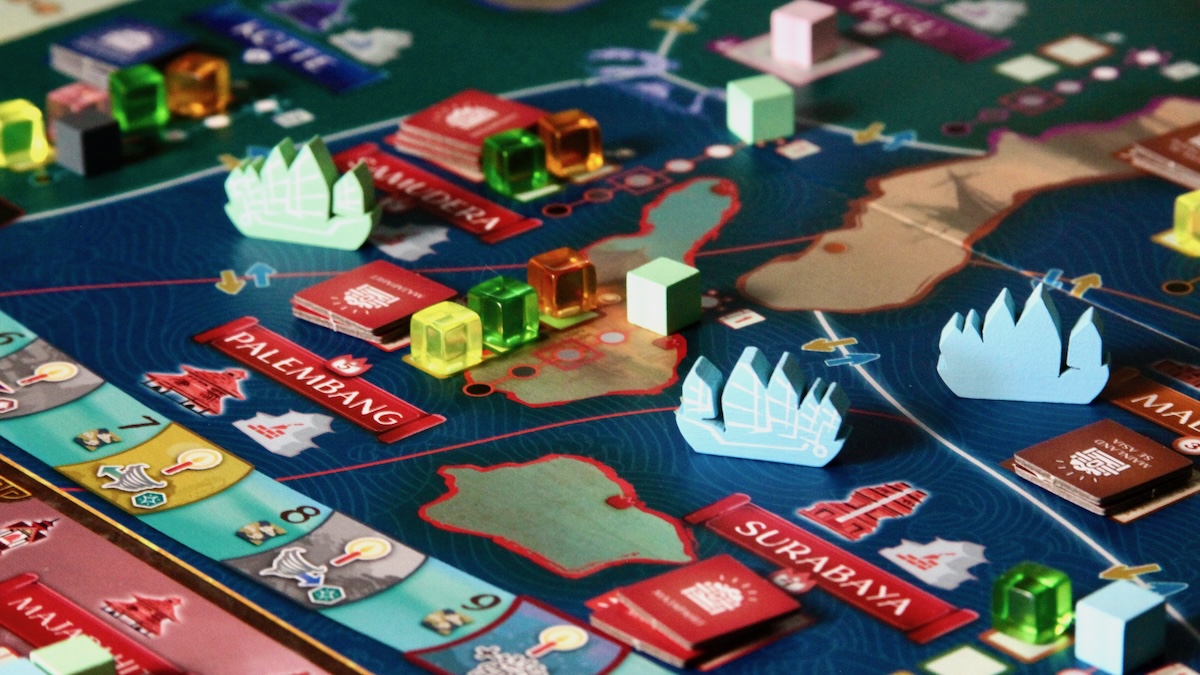

The emperor is dead and dissent is spreading through the court. You are a proud supporter of Admiral Zheng He as he embarks on his final voyage to the West Ocean. You will sail by his side in an attempt to reverse the fate of the empire and to define your own legacy.
Ultimate Voyage is a historical action-selection game for 1-4 players. Take turns sailing, trading, engaging in combat, negotiating, and constructing structures to earn glory in 15th-century China. Can you help build the Porcelain Tower and write the most captivating story on your Ultimate Voyage?
Game at a Glance
- Players: 1-4
- Age: 14+
- Playtime: 60-120 min
- Kickstarter Link: https://www.kickstarter.com/projects/littlemonks/ultimate-voyage-final-quest-of-the-treasure-fleet
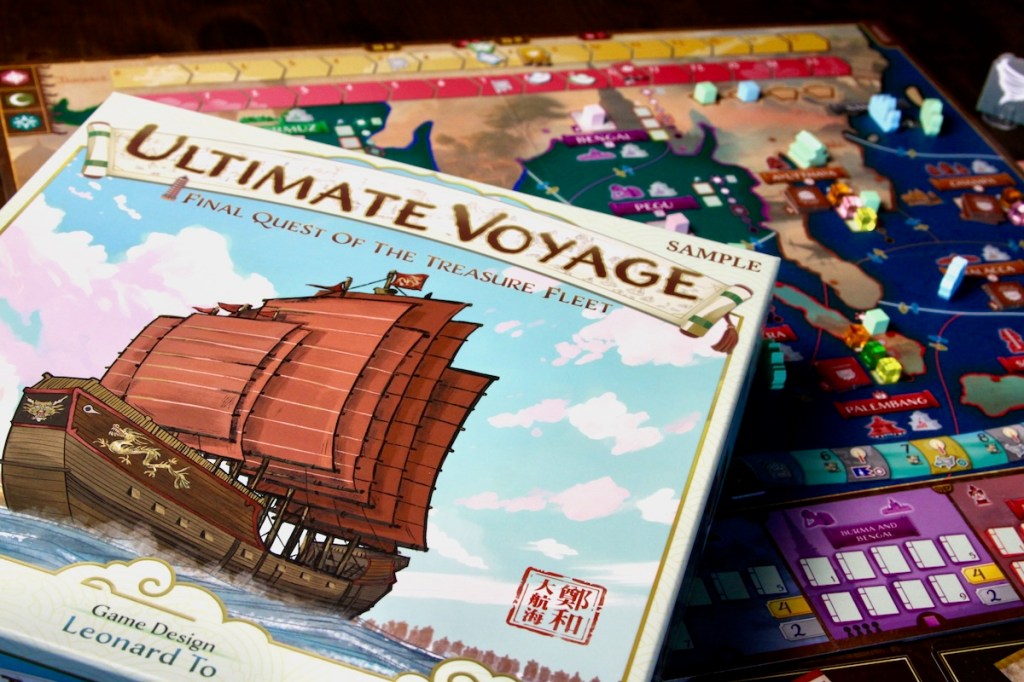
The game shown in this preview is a prototype; components and gameplay in the final version are subject to change
Skip to Gameplay, Skip to Impressions
Setup and Rules Overview
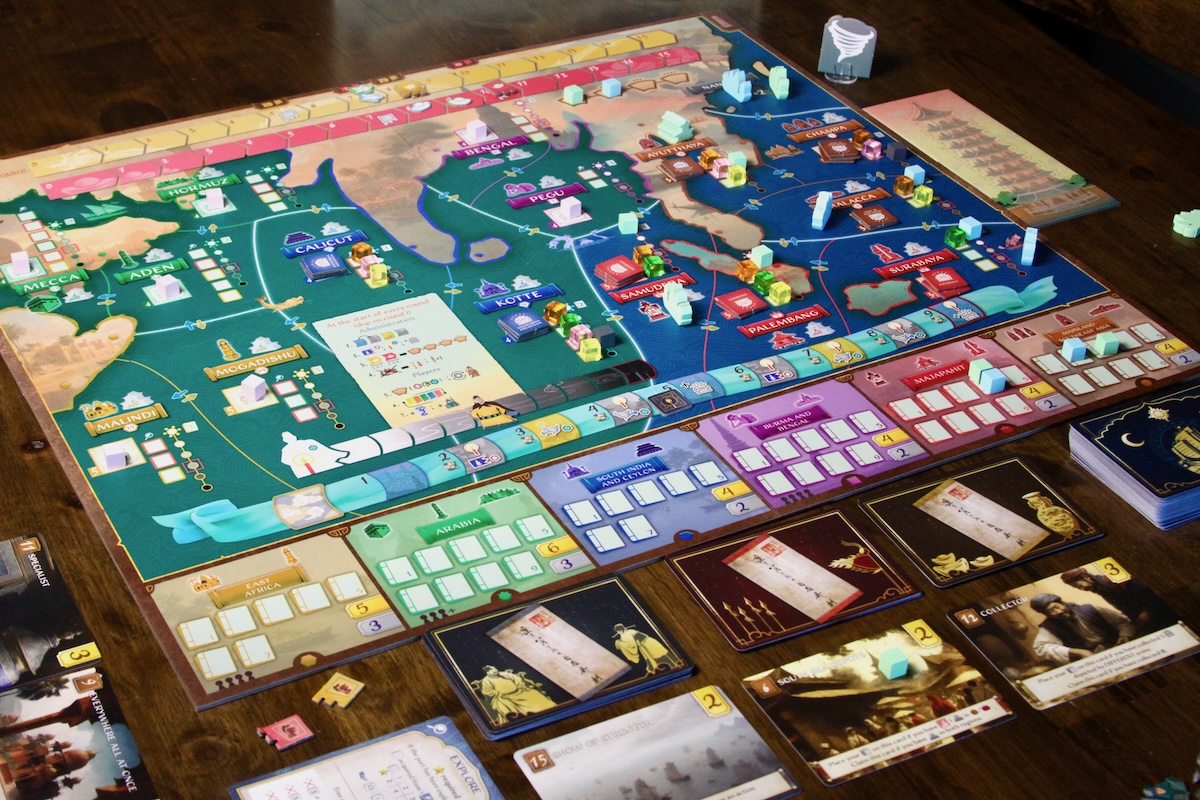
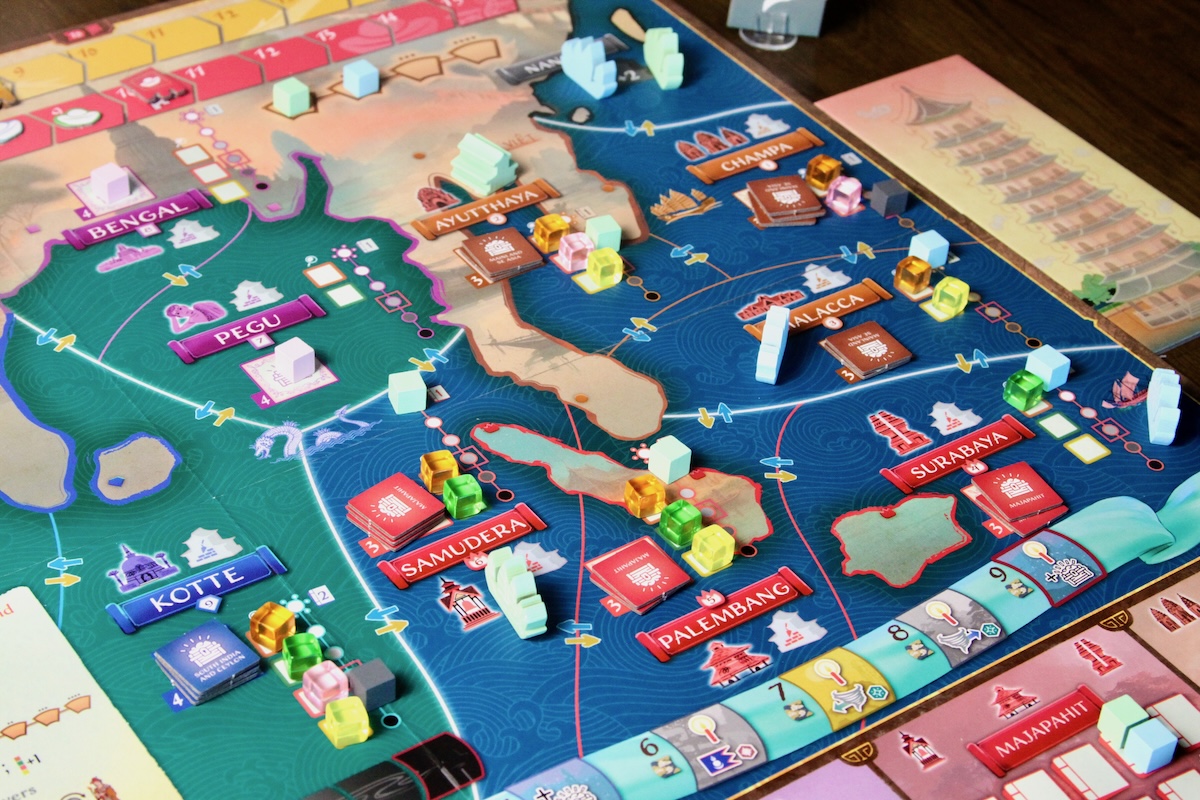
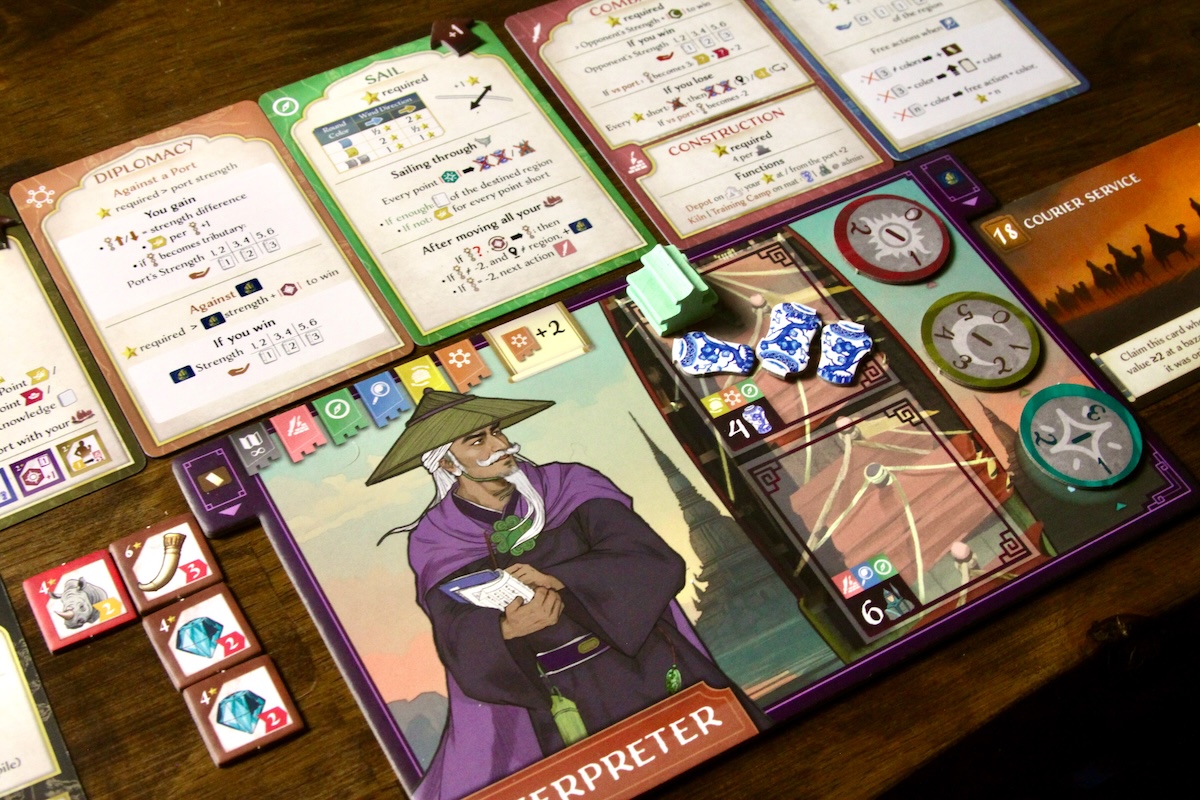
The game takes place on a map board where players will send their ships to various ports. The ports on the map are populated with knowledge tokens and trade goods. The Encounter Cards and Objective Cards are shuffled and the top 3 Objectives from each deck are displayed. Players choose one of the six slightly asymmetric character mats and take the corresponding resources.
Ultimate Voyage takes place over several rounds. The game will end at round nine but could end earlier if certain game events are triggered. The rounds are divided into two main phases: Administrative and Action. The Administrative Phase consists of all the round-upkeep necessary to keep the game flowing smoothly. Events are discussed, and players look for fortune in the stars by rolling the Deity Dice, organizing action cards, etc. The Action phase is self-explanatory – players will take turns choosing an action card, calculating its action point strength, and resolving its effects. This continues until all players are out of action (three actions per player per round).
The goal is to earn profit and prestige, write a compelling story to go down in the history books and bring back trade goods and news of favorable relations to help build the Porcelain Tower of Nanjing. In addition, players can work towards completing public and private objectives.
The five main actions are as follows:
- Sail – Moves ship(s) about the map. The wind and any storm activity affect this action’s success.
- Combat or Construction – Combat may occur at a port in an attempt to install a new ruler, thus improving the port’s affiliation with the fleet. Players may instead choose to spend their action points on constructing buildings which may boost future action strength in various ways.
- Diplomacy – Better relations to increase a port’s affiliation with the fleet.
- Explore – Collect knowledge tokens from a port. These tokens may be turned in to upgrade actions and obtain private objectives.
- Trade – Privately examine the trade goods at a port’s bazaar and spend the action strength to obtain one.
The end game can be triggered by completing nine rounds (six during a quick game). It may end earlier if Zheng He’s health track moves too far right, a player reaches 15 on both the Prestige and Profit track, or someone has completed four objectives.
Gameplay
This game does a lot to immerse players into this historical world. Players must reconcile with weather patterns, port hostility, loss of cargo and lives during storms, haggling for goods at the bazaar, collecting knowledge from explorations, and more. This wide scope of considerations requires a lengthy procedure and plenty of player upkeep. Fortunately, the board has reminders to ensure the Administrative Phase is followed correctly, and the cards are full of explanatory text that helps players navigate the Action Phase.
The game has some luck in the form of encounters and dice rolls. The encounter cards add surprise challenges to overcome for rewards. The three Deity Dice in the game are rolled during the Administrative Phase. They determine the Deity Dial power for every player at the table. The dials boost or hamper an action’s power and each must be used every round. Although the dice can bring both good and bad fortune, that fortune is shared amongst every player, negating any luck bias and putting everyone on an equal playing field.
The actions use an action point system. Card actions are boosted by their position in a card array, getting assigned a power level of 1-5 depending on their position. When an action is chosen, the player must use a Deity Dial to adjust the power up or down, depending on what was rolled in the Admin Phase. The more power behind an action, the higher the chance for success. At the end of the round, players must slide their two unused actions to the right and then reorder their used cards as they see fit to the left of the unused actions. This prevents players from spamming their preferred action and creates a personal puzzle to work through as you navigate the map.
Six asymmetric character mats and variable setups add to the game’s replayability. Additionally, there are four major pathways to score points. How you bring prestige, profit, and glory to the empire is entirely up to you. You can write a new story each game.
The game has some indirect interaction, but I never experienced direct conflict with my opponent during my plays. There is competition for resources and knowledge at the ports and to write the most epic stories in each region through an area majority mechanic. Additionally, other players’ actions can affect the board state for everybody else – most notably when a player accidentally turns a port hostile.
The rulebook includes rules for a quick play mode and a solo experience. I think the rulebook could use some reworking to ease the learning process.
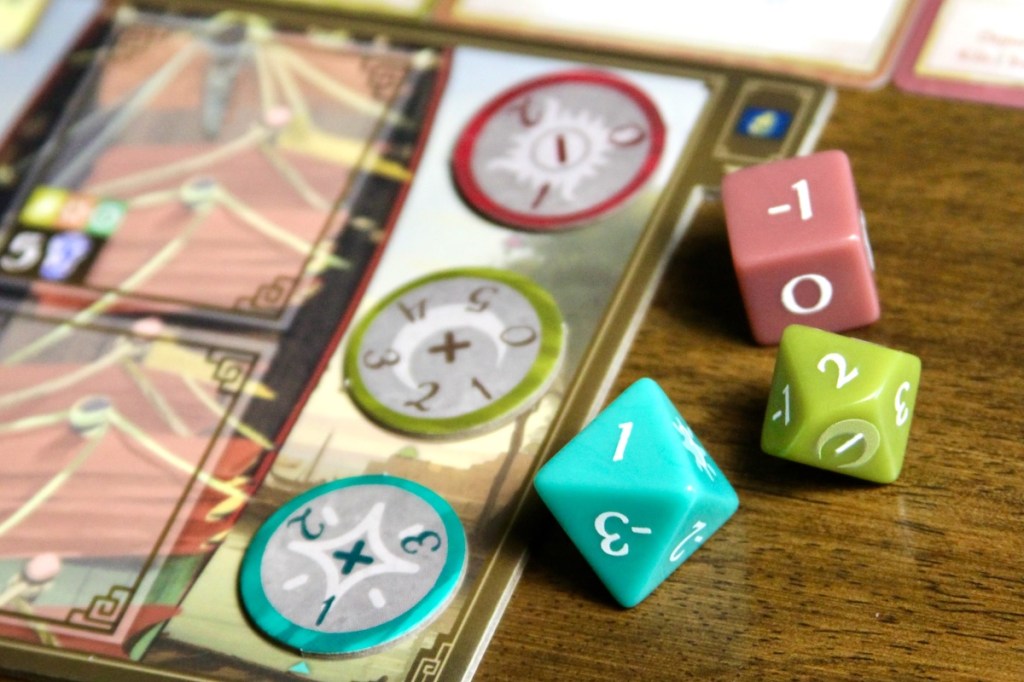
Deity Dice set the Deity Dials for all players 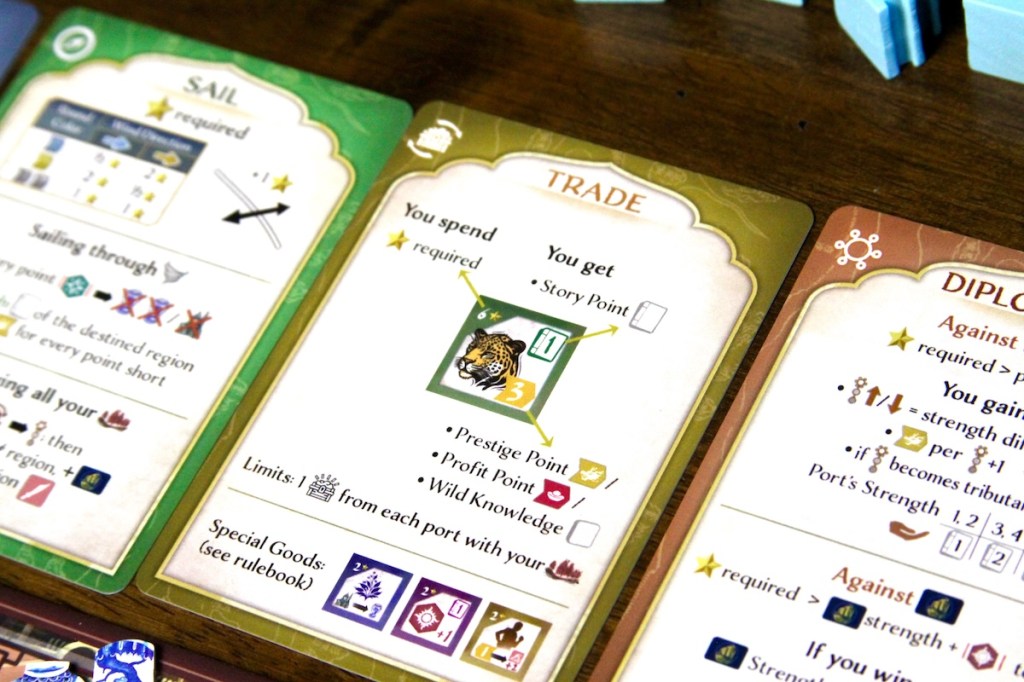
The actions are described on each card 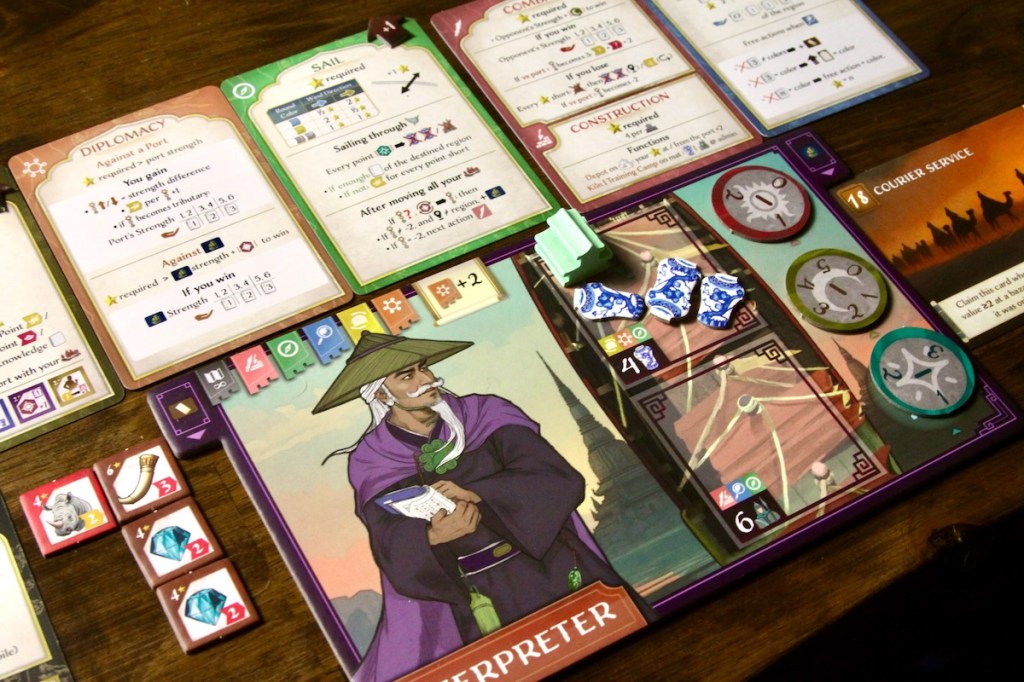
The cards increase in power from left to right 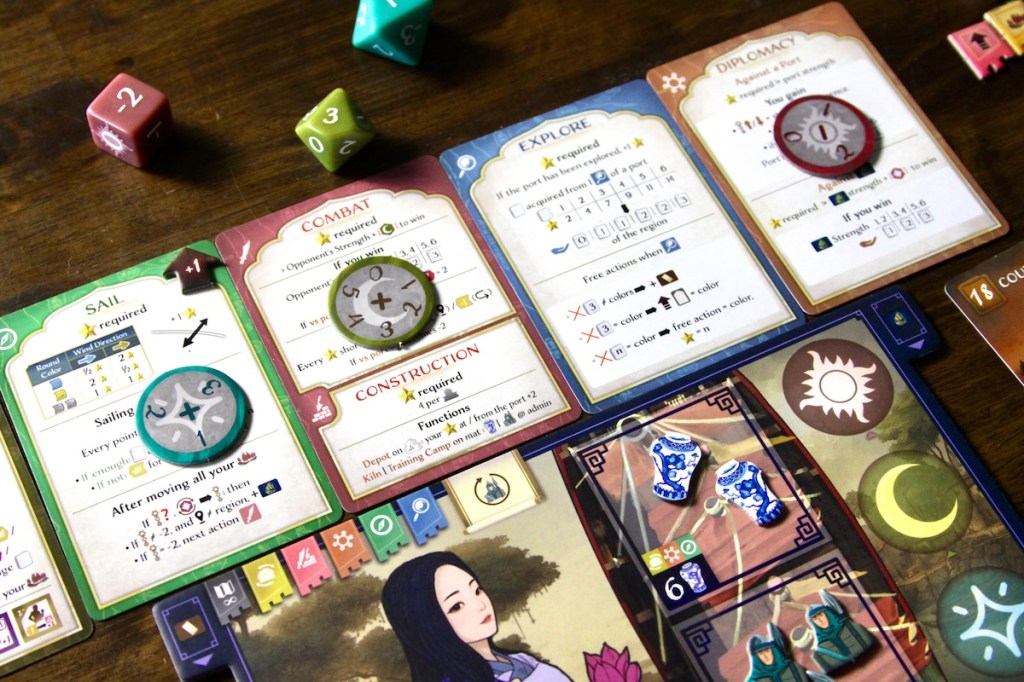
Deity dials modify action points 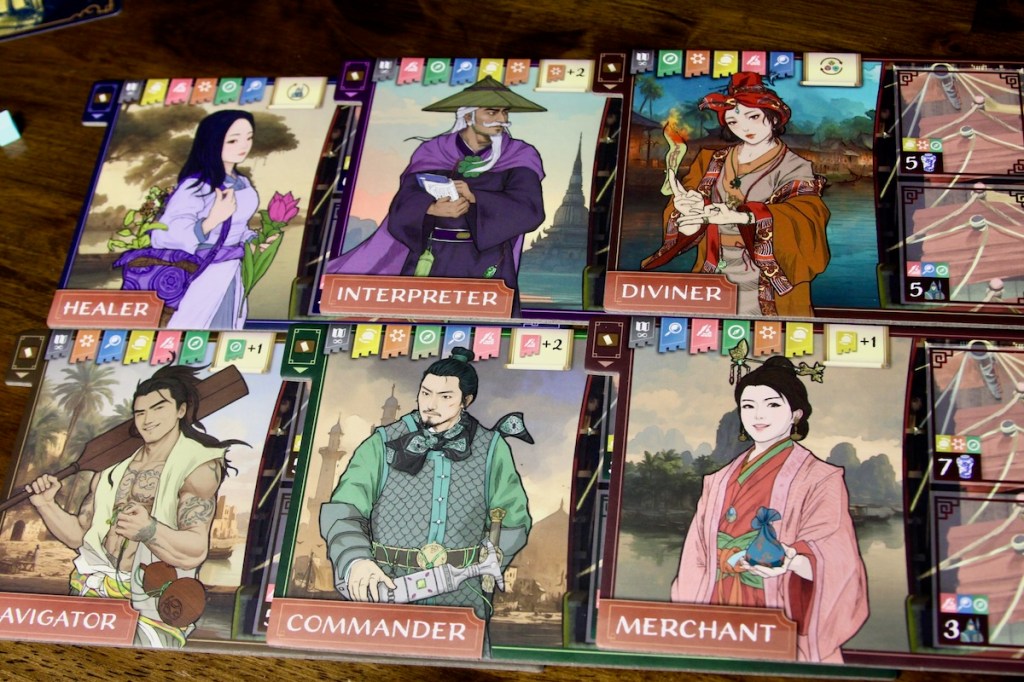
There are 6 asymmetric characters 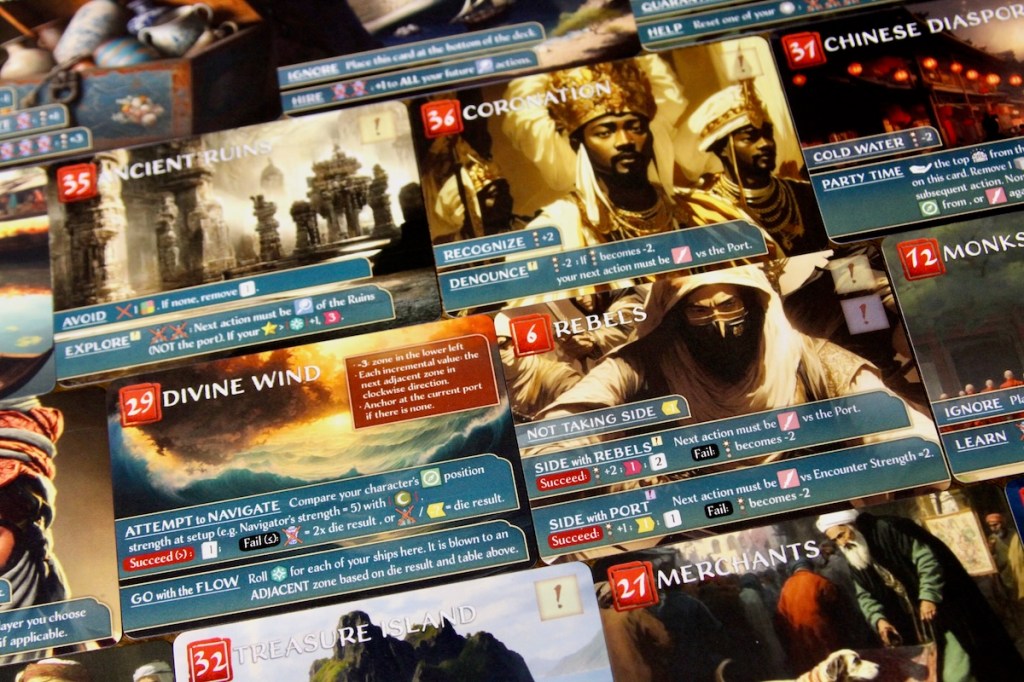
A selection of event cards 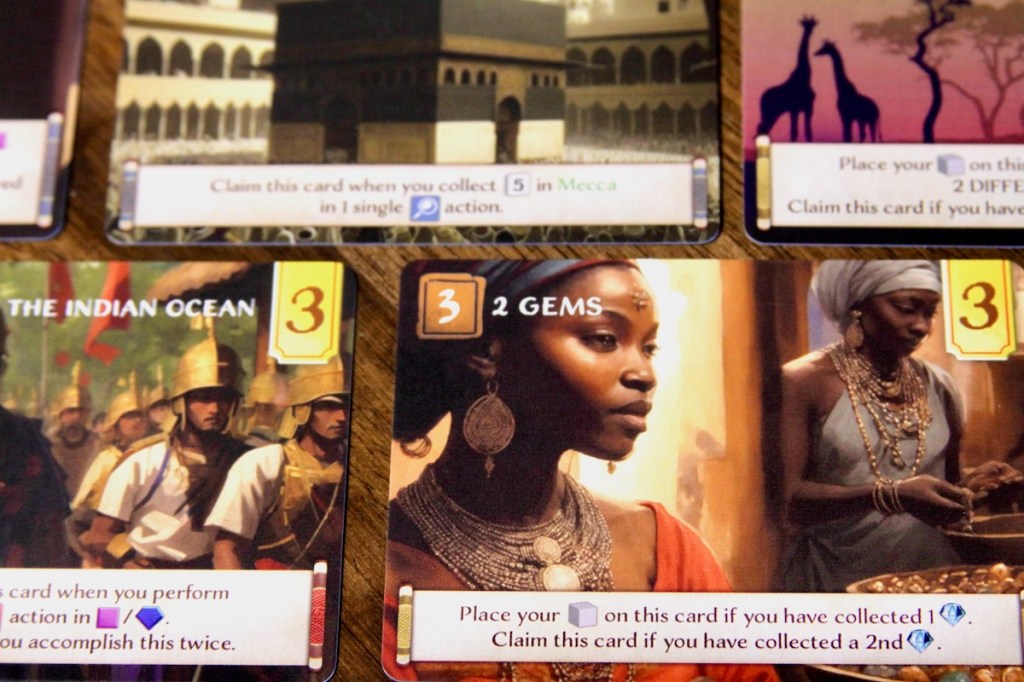
A selection of objective cards 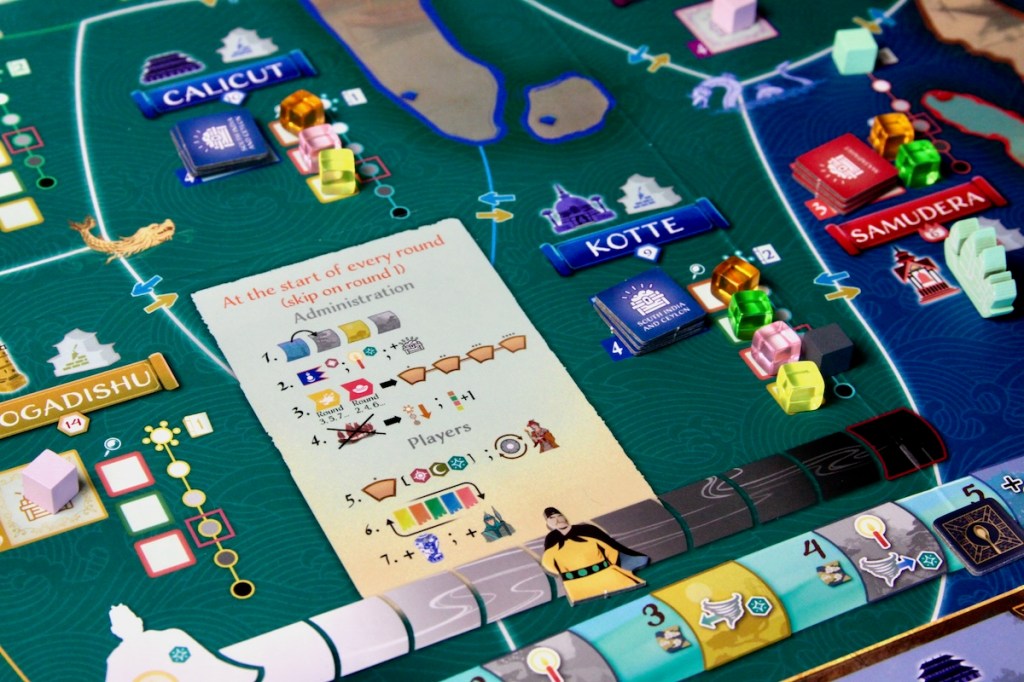
Administrative phase steps are on the main board 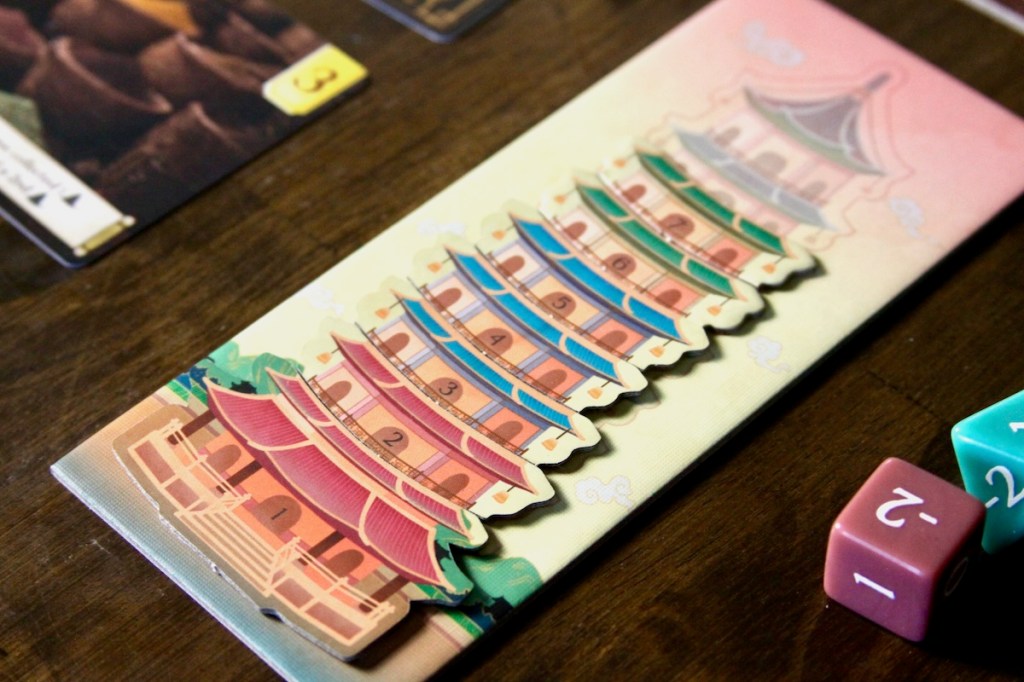
Players work together to build the porcelain tower
Impressions
The game is designed in painstaking detail to bring Zheng He’s final voyage to life. There is meticulous attention to cultural and historical elements – the game even tries to emulate real monsoon wind patterns. The designer has leaned heavily into this theme which is recognizable in the art, flavor text, and mechanics present in the game.
The standout feature for me was the action card puzzle. I liked figuring out how to re-order my actions and working out how to use my modifiers to take the most efficient actions. It was always a pleasure to get a positive power boost, but the negative adjustments were a fun problem to solve, also. There was a lot of freedom in how I planned my adventure, from which ports I wanted to visit to how I felt like resolving conflict, and that was appreciated.
A lot is going on in Ultimate Voyage. Players need to consider weather patterns, conflict, surprising encounters, Zheng He’s health, and more. This game can be an immersive historical experience if you’re willing to learn and manage the procedure required to play. The in-game upkeep is on the higher end of what I normally prefer so that is something to consider for those who feel similarly. For those who don’t mind a bit of administrative upkeep, and especially those who appreciate delving into history, Ultimate Voyage is likely a great fit.
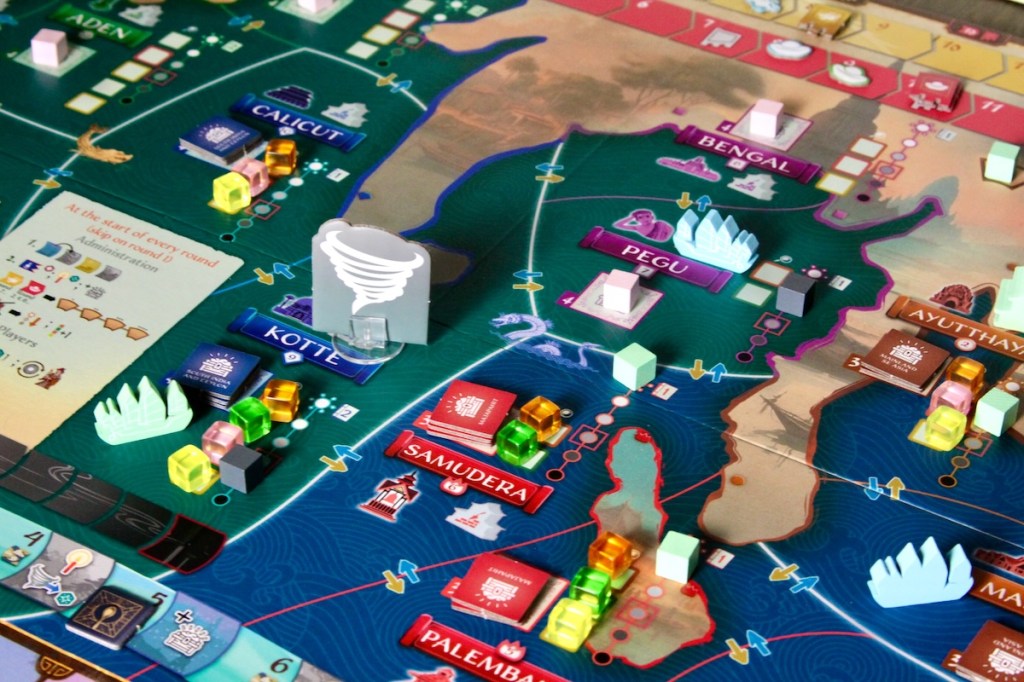
Ultimate Voyage is available for crowdfunding on Kickstarter October 2024. Follow the link to learn more:
https://www.kickstarter.com/projects/littlemonks/ultimate-voyage-final-quest-of-the-treasure-fleet
 Tabletop Mom